
How Is the Loan Amount Calculated for a Mortgage Loan?
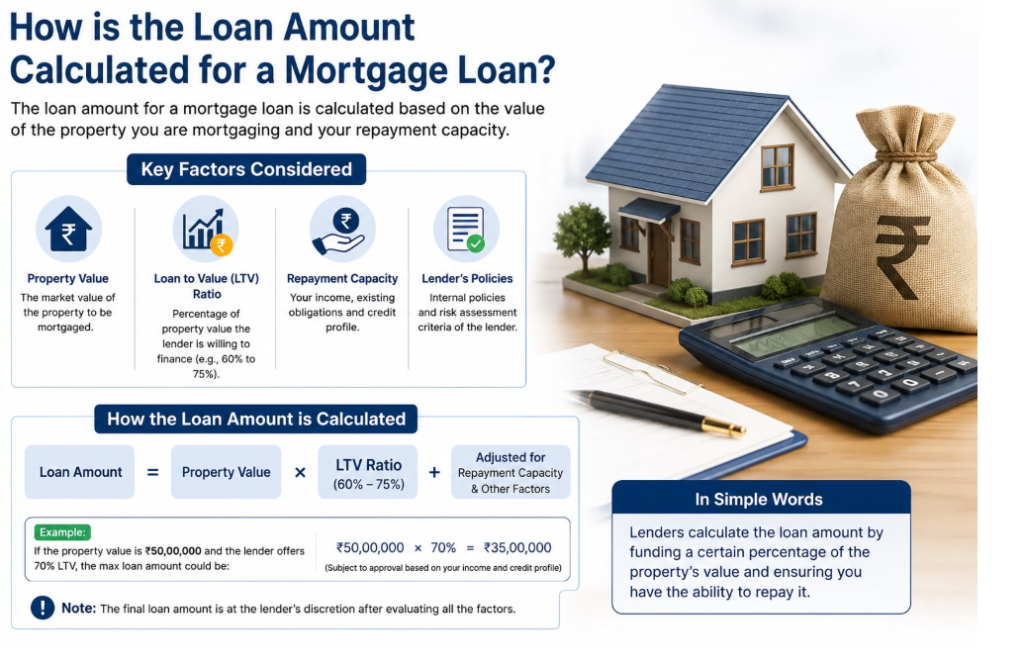
A mortgage loan, also known as a Loan Against Property (LAP), is a secured loan where borrowers pledge their residential, commercial, or industrial property as collateral to obtain funds. One of the most common questions borrowers ask is, “How is the loan amount calculated for a mortgage loan?” The answer depends on several factors, including the property’s market value, the borrower’s income, repayment capacity, and the lender’s policies. Understanding how lenders calculate the loan amount can help you estimate your eligibility and prepare your application more effectively. 1. Property Market Value The first step in calculating the loan amount is determining the current market value of the property. Banks and financial institutions appoint technical experts to inspect and evaluate the property based on factors such as: The higher the market value, the greater the potential loan amount. 2. Loan-to-Value (LTV) Ratio After determining the property’s value, lenders apply the Loan-to-Value (LTV) ratio. Most banks and NBFCs provide 50% to 75% of the property’s market value as a mortgage loan. For example: The exact LTV depends on the lender’s internal policy and the property’s characteristics. 3. Income and Repayment Capacity Even if your property has a high market value, lenders will evaluate whether your income is sufficient to repay the loan. They assess: A stable income and lower financial obligations generally improve your loan eligibility. 4. Credit Score Your credit score is another important factor in loan calculation. A score of 750 or above demonstrates responsible credit behavior and increases the likelihood of receiving a higher loan amount at competitive interest rates. 5. Existing Financial Liabilities Banks also review your existing loans, credit card balances, and other financial commitments. Lower outstanding liabilities improve your repayment capacity and may increase the loan amount. 6. Property Documentation The property must have clear ownership and complete legal documentation. Any legal disputes or missing documents may reduce the approved loan amount or even result in rejection. How Capex Finvest Services Can Help Calculating the right mortgage loan amount requires proper evaluation of both the property and the borrower’s financial profile. Capex Finvest Services helps customers understand their eligibility, compare loan offers from leading banks and NBFCs, and complete the documentation process smoothly. Whether you are a salaried employee, self-employed professional, or business owner, Capex Finvest Services provides expert guidance to help you secure the maximum eligible loan amount with competitive interest rates and quick processing. Tips to Increase Your Mortgage Loan Eligibility To maximize your approved loan amount: Conclusion The loan amount for a mortgage loan is calculated based on several factors, including the property’s market value, Loan-to-Value ratio, income, repayment capacity, credit score, and legal status of the property. Most lenders finance 50% to 75% of the property’s value, subject to eligibility. By applying through Capex Finvest Services, borrowers can receive professional assistance in evaluating eligibility, selecting the right lender, and securing the best mortgage loan solution for their financial needs
What Is the Maximum Loan Amount on a Mortgage Loan?
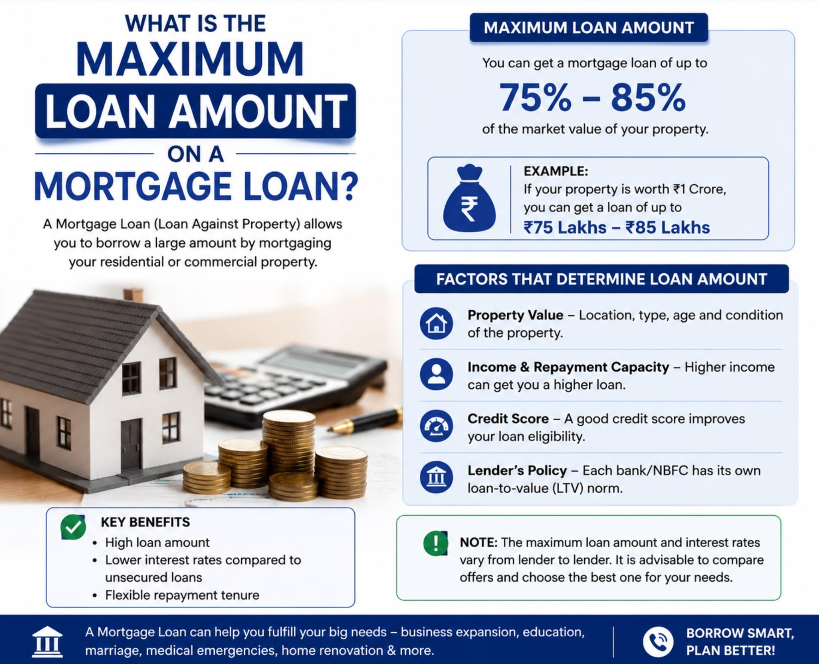
A mortgage loan, also known as a Loan Against Property (LAP), is one of the most popular financing options for individuals and businesses who need access to large amounts of funds without selling their property. By mortgaging a residential, commercial, or industrial property, borrowers can obtain substantial funding at competitive interest rates. One of the most frequently asked questions is, “What is the maximum loan amount on a mortgage loan?” The answer depends on several factors, including the property’s market value, the applicant’s income, repayment capacity, and the lender’s internal policies. How Is the Maximum Loan Amount Calculated? Most banks and financial institutions offer a mortgage loan of 50% to 75% of the property’s current market value. This percentage is called the Loan-to-Value (LTV) ratio. For instance, if your property is valued at ₹1 crore, you may be eligible for a mortgage loan of approximately ₹50 lakh to ₹75 lakh, subject to your financial eligibility. However, the final approved amount is not based solely on the property’s value. Lenders also evaluate your income, credit history, existing liabilities, and repayment capacity before sanctioning the loan. Factors That Determine the Maximum Mortgage Loan Amount 1. Property Value The lender conducts a technical evaluation to determine the current market value of your property. A well-maintained property in a prime location generally receives a higher valuation. 2. Income and Repayment Capacity Whether you are a salaried employee, self-employed professional, or business owner, your monthly income plays a significant role in determining the loan amount. Higher and stable income improves your borrowing capacity. 3. Credit Score A credit score of 750 or above is generally preferred by lenders. A good repayment history increases your chances of securing a higher loan amount with better interest rates. 4. Existing Loan Obligations Banks assess your current EMIs and outstanding debts before approving a mortgage loan. Lower financial obligations improve your eligibility. 5. Property Documentation The property should have a clear title, proper legal documentation, and should be free from legal disputes or encumbrances. Benefits of a Mortgage Loan Mortgage loans offer several advantages over unsecured loans, including: How Capex Finvest Services Can Help Choosing the right lender is just as important as meeting the eligibility criteria. Capexloan.com assists customers in comparing mortgage loan options from leading banks and NBFCs. Our experts help evaluate your eligibility, guide you through documentation, coordinate property valuation, and support you throughout the approval process. Whether you are a salaried individual, self-employed professional, or business owner, Capex Finvest Services is committed to helping you secure the maximum eligible loan amount with competitive interest rates and minimal hassle. Tips to Maximize Your Mortgage Loan Eligibility To improve your chances of obtaining a higher mortgage loan amount: Conclusion The maximum loan amount on a mortgage loan depends on your property’s market value, income, repayment capacity, credit profile, and the lender’s policies. Most lenders finance 50% to 75% of the property’s value, subject to eligibility and verification. With expert assistance from Capex Finvest Services, you can simplify the application process, compare offers from multiple lenders, and secure the best mortgage loan that meets your financial needs. By preparing your documents and maintaining a healthy financial profile, you can maximize your chances of obtaining a higher loan amount with favorable terms.
How Much Loan Can I Get Against My Property?
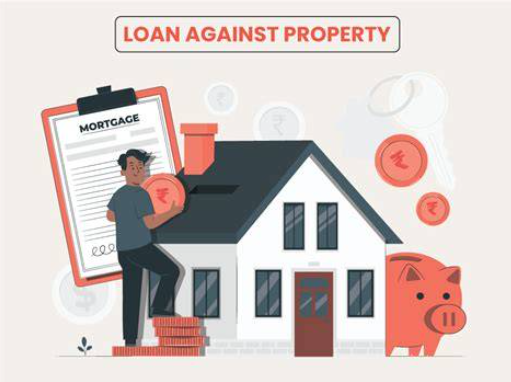
If you are planning to raise funds for personal or business needs, you may be wondering, “How much loan can I get against my property?” A Loan Against Property (LAP), also known as a mortgage loan, allows you to borrow money by pledging your residential, commercial, or industrial property as collateral. The loan amount you can receive depends on several factors, including the property’s market value, your income, repayment capacity, and the lender’s policies. In most cases, banks and financial institutions in India offer 50% to 75% of the property’s current market value as a mortgage loan. For example, if your property is valued at ₹1 crore and the lender offers up to 70% financing, you may be eligible for a loan of up to ₹70 lakh. However, the final approved amount is determined after evaluating both your property and your financial profile. Factors That Determine Your Loan Amount 1. Market Value of the Property The most important factor is the current market value of the property you are mortgaging. Before approving the loan, the lender appoints a qualified valuer to inspect the property and determine its fair market value. A higher property valuation generally increases your loan eligibility. 2. Type of Property The type of property also influences the loan amount. Residential, commercial, and industrial properties are commonly accepted as collateral. Properties located in prime locations with clear legal titles usually receive better valuations and higher loan eligibility. 3. Income and Repayment Capacity Your monthly income and repayment capacity play a significant role in determining how much you can borrow. Lenders assess your salary or business income, existing financial obligations, and debt-to-income ratio to ensure that you can comfortably repay the loan. 4. Credit Score A good CIBIL score, typically 750 or above, improves your chances of getting a higher loan amount and may also help you secure competitive interest rates. A poor credit history may reduce your eligibility or lead to stricter loan terms. 5. Loan-to-Value (LTV) Ratio The Loan-to-Value (LTV) ratio is the percentage of the property’s value that a lender is willing to finance. Most lenders offer an LTV of 50% to 75%, depending on the property’s condition, location, legal status, and the borrower’s financial profile. Documents Required To determine your eligible loan amount, lenders generally require: Providing complete and accurate documents helps speed up the approval process. How Capex Finvest Services Can Help If you are unsure about how much loan you can get against your property, Capexloan.com can guide you through the entire process. Their experienced professionals assess your financial profile, evaluate your eligibility, and help you compare mortgage loan options from multiple banks and financial institutions. They also assist with documentation, property evaluation, and application submission, making the process simple and hassle-free. Whether you need funds for business expansion, education, medical expenses, home renovation, or debt consolidation, Capex Finvest Services helps you identify the most suitable mortgage loan based on your requirements. Tips to Increase Your Loan Eligibility You can improve your chances of receiving a higher loan amount by: Conclusion The amount you can borrow against your property depends on factors such as the property’s market value, your income, repayment capacity, credit score, and the lender’s Loan-to-Value ratio. While most lenders offer 50% to 75% of the property’s value, the final loan amount varies from one applicant to another. Before applying, it is advisable to assess your eligibility and compare different loan options. With expert assistance from Capex Finvest Services, you can understand your borrowing capacity, choose the right lender, and enjoy a smooth mortgage loan application process tailored to your financial goals.
What Is the Minimum Age Required for a Mortgage Loan?

If you are planning to apply for a mortgage loan, one of the first questions you may have is, “What is the minimum age required for a mortgage loan?” Age is an important eligibility criterion that banks and financial institutions consider before approving a Loan Against Property (LAP). Understanding the age requirements can help you determine whether you qualify and plan your finances effectively. In India, the minimum age required to apply for a mortgage loan is generally 21 years. However, the exact age criteria may vary from one lender to another. Some financial institutions may have slightly different requirements depending on the applicant’s employment type, income stability, and repayment capacity. Why Is There a Minimum Age Requirement? Lenders set a minimum age to ensure that the borrower has a stable source of income and the financial responsibility to repay the loan. By the age of 21, most applicants have either started their careers or established a business, making it easier for lenders to assess their repayment capability. Apart from the minimum age, lenders also specify a maximum age at loan maturity, which is generally between 60 and 70 years. This ensures that the borrower can comfortably repay the loan during their earning years. Does Age Alone Decide Loan Eligibility? No. While meeting the minimum age requirement is essential, lenders evaluate several other factors before approving a mortgage loan. These include: Even if you meet the minimum age requirement, your loan application may still be evaluated based on these additional criteria. Age Criteria for Different Applicants Salaried Individuals Most banks allow salaried employees aged 21 years and above to apply for a mortgage loan. A stable job and regular monthly income improve the chances of approval. Self-Employed Professionals Doctors, lawyers, chartered accountants, architects, consultants, and other professionals can generally apply from the age of 21 years, provided they have a stable source of income and satisfactory business records. Business Owners Business owners and entrepreneurs can also apply if they meet the minimum age requirement and have a profitable, well-established business. Lenders usually evaluate business turnover, income tax returns, and financial statements. Documents Required To apply for a mortgage loan, applicants are generally required to submit: Submitting complete and accurate documents can help speed up the approval process. How Capex Finvest Services Can Help Applying for a mortgage loan can seem complicated, especially if you are applying for the first time. Capexloan.com helps customers understand their eligibility, including age requirements, income criteria, and documentation. Their experienced team assists applicants in comparing loan options from multiple lenders, preparing the necessary paperwork, and choosing the most suitable mortgage loan based on their financial profile. Whether you are a salaried employee, self-employed professional, or business owner, Capex Finvest Services simplifies the loan process and helps you connect with trusted lending partners offering competitive interest rates and flexible repayment options. Conclusion The minimum age required for a mortgage loan is typically 21 years, although specific eligibility criteria may differ between lenders. Along with age, factors such as income, credit score, property value, and repayment capacity play a significant role in loan approval. Before applying, ensure that you meet all the lender’s requirements and keep your documents ready. With expert guidance from Capex Finvest Services, you can make the mortgage loan application process smoother and improve your chances of securing the right financing for your personal or business needs.
Can NRIs Get a Mortgage Loan?
One of the most common questions among overseas Indians is, “Can NRIs get a mortgage loan?” The answer is yes. Many banks and financial institutions in India offer mortgage loans to eligible Non-Resident Indians (NRIs), subject to their lending policies. An NRI can obtain a Loan Against Property by mortgaging a residential or commercial property located in India. These loans are commonly used for business investments, education, medical expenses, property renovation, or other legitimate financial requirements. To qualify, lenders evaluate factors such as income earned abroad, employment stability, repayment capacity, property ownership, and credit profile. Since income is earned outside India, applicants may also need to submit overseas employment documents, passport, visa, work permit, overseas address proof, bank statements, and Indian property documents. Most lenders require EMIs to be repaid through an NRE or NRO bank account. In certain cases, a power of attorney may be needed if the borrower cannot be physically present in India during the loan process. Interest rates, loan tenure, and maximum loan amount vary depending on the lender and the applicant’s profile. Having a clear property title, regular income, and complete documentation significantly improves the chances of loan approval. Capexloan.com assists NRIs in understanding mortgage loan eligibility, collecting the required documents, comparing lenders, and completing the application process with ease. Their expert guidance helps overseas borrowers secure suitable financing while minimizing delays. In conclusion, NRIs can successfully obtain a mortgage loan in India if they satisfy the lender’s eligibility requirements. With professional assistance from Capex Finvest Services, NRIs can enjoy a streamlined loan application process and access financing tailored to their individual financial needs.
Can Salaried Employees Apply for a Mortgage Loan?

Yes, salaried employees can apply for a mortgage loan if they meet the eligibility criteria established by banks and financial institutions. A mortgage loan, or Loan Against Property (LAP), enables borrowers to obtain funds by pledging their residential, commercial, or industrial property while retaining ownership. Lenders generally prefer salaried applicants because they receive a fixed monthly income, making repayment more predictable. Government employees, public sector employees, and private sector professionals are all eligible, provided they satisfy the lender’s age, income, and credit requirements. To assess eligibility, lenders review salary slips, bank statements, employment history, Form 16, CIBIL score, and existing financial obligations. A stable job, regular income, and good repayment history increase the chances of approval and may help borrowers secure competitive interest rates. Mortgage loans can be used for various purposes, including home renovation, business expansion, education expenses, medical emergencies, marriage expenses, or debt consolidation. Applicants are generally required to submit identity proof, address proof, PAN card, Aadhaar card, salary slips, bank statements, and property ownership documents. https://capexloan.com supports salaried employees by helping them compare mortgage loan offers from different lenders, understand eligibility requirements, and complete documentation smoothly. Their experienced professionals assist borrowers throughout the application process to ensure a hassle-free experience. Overall, salaried employees are among the most eligible applicants for mortgage loans due to their stable income and repayment capacity. Seeking guidance from Capex Finvest Services can help you choose the right loan with competitive interest rates and flexible repayment options.
Can Self-Employed Individuals Apply for a Mortgage Loan?

Yes, self-employed individuals can apply for a mortgage loan. In fact, many banks and financial institutions actively provide Loan Against Property (LAP) facilities to self-employed professionals, business owners, traders, and entrepreneurs. To determine eligibility, lenders evaluate several factors, including business stability, annual turnover, profit, repayment capacity, credit history, and property value. Applicants are generally required to provide income tax returns, GST returns (if applicable), bank statements, business proof, and property documents. Self-employed professionals such as doctors, architects, chartered accountants, consultants, and lawyers are also eligible, provided they have a stable source of income. Business owners often use mortgage loans for working capital, business expansion, machinery purchase, inventory management, office renovation, or debt consolidation. One major advantage of a mortgage loan is that it usually offers lower interest rates than unsecured business loans, as the loan is secured against property. Additionally, borrowers benefit from higher loan amounts and longer repayment tenures. Maintaining a healthy CIBIL score, filing income tax returns regularly, and keeping proper financial records significantly improve the chances of loan approval. https://capexloan.com helps self-employed individuals evaluate their eligibility, prepare documentation, compare loan offers, and complete the application process efficiently. Their experienced team works with multiple lenders to help customers find mortgage loans that match their financial requirements. In summary, self-employed individuals are fully eligible for mortgage loans if they meet the lender’s income, documentation, and property requirements. With expert assistance from Capex Finvest Services Pvt. Ltd., the application process becomes faster, simpler, and more convenient.
What Is the Maximum Age Limit for a Mortgage Loan?

A mortgage loan, also known as a Loan Against Property (LAP), is one of the most popular financing options for individuals and businesses looking to meet large financial requirements. While many borrowers know that there is a minimum age requirement, they often ask, “What is the maximum age limit for a mortgage loan?” Understanding this criterion is important before applying for a loan. Most banks and financial institutions in India allow borrowers to apply for a mortgage loan up to a certain age. Generally, the maximum age at the time of loan maturity ranges between 60 and 70 years. For salaried individuals, lenders often expect the loan to be repaid before retirement, while self-employed professionals and business owners may be allowed a higher age limit if they can demonstrate a stable income. The maximum age limit is determined to reduce the lender’s risk and ensure that borrowers have a reliable source of income throughout the loan tenure. Along with age, lenders evaluate your monthly income, credit score, repayment capacity, employment stability, and the market value of the property being mortgaged. If you are nearing the maximum age limit, you can still improve your chances of approval by choosing a shorter loan tenure, adding a younger co-applicant, maintaining a good CIBIL score, and submitting complete financial documents. Capexloan.com assists borrowers in understanding lender-specific age criteria and helps them choose the right mortgage loan based on their eligibility. Whether you are a salaried employee, self-employed professional, or business owner, their experts simplify the loan process and connect you with trusted lending partners. In conclusion, while the maximum age limit for a mortgage loan generally ranges from 60 to 70 years, the final eligibility depends on the lender’s policies and your financial profile. Consulting professionals like Capex Finvest Services can help you find the most suitable mortgage loan with flexible repayment options
Am I Eligible for a Mortgage Loan?

If you are planning to apply for a mortgage loan, one of the first questions that comes to mind is, “Am I eligible for a mortgage loan?” The answer depends on several factors, including your income, age, property value, repayment capacity, and credit history. A mortgage loan, also known as a Loan Against Property (LAP), allows you to borrow money by pledging your residential, commercial, or industrial property as collateral while continuing to own and use it. Most banks and financial institutions evaluate your eligibility based on your financial profile. Salaried employees, self-employed professionals, business owners, and even some pensioners may qualify for a mortgage loan if they meet the lender’s requirements. Generally, applicants should be between 21 and 65 years of age, although the exact age criteria may vary depending on the lender. One of the most important factors in determining mortgage loan eligibility is your income. Lenders assess your monthly income to ensure that you can comfortably repay the loan. A stable source of income and a healthy debt-to-income ratio improve your chances of approval. If you are self-employed, your business income, financial statements, and income tax returns are typically considered during the evaluation process. Another key factor is the market value of the property you plan to mortgage. Most lenders offer a loan amount ranging from 50% to 75% of the property’s market value, depending on the property’s type, location, condition, and legal status. The property should have a clear title and all the necessary legal approvals to qualify as acceptable collateral. Your credit score, commonly referred to as the CIBIL score in India, also plays a significant role. A score of 750 or above is generally considered favorable and can increase the likelihood of approval while helping you secure competitive interest rates. However, applicants with lower scores may still be eligible, depending on their overall financial profile and the lender’s internal policies. When applying for a mortgage loan, you will usually need to submit documents such as identity proof, address proof, income proof, bank statements, income tax returns (if applicable), and property-related documents. Having complete and accurate documentation can make the approval process faster and smoother. If you are unsure whether you qualify, consulting a trusted financial advisor or loan expert can save time and help you understand your borrowing capacity. Capex Finvest Services assists customers in assessing their mortgage loan eligibility and connecting them with suitable lending partners based on their financial profile. Their experienced team can guide applicants through documentation, eligibility assessment, and the loan application process, making the experience more convenient. Improving your eligibility is also possible before applying. Maintaining a good credit score, reducing existing debts, filing income tax returns regularly, and ensuring your property documents are legally clear can significantly strengthen your application. In conclusion, eligibility for a mortgage loan depends on a combination of factors rather than a single criterion. By maintaining a stable income, a healthy credit profile, and proper property documentation, you can improve your chances of getting your loan approved. If you need professional guidance, Capexloan.com can help you understand your eligibility and assist you in finding the right mortgage loan solution to meet your financial needs
Is Personal Loan Insurance Really Necessary When You Take a Loan?

Taking a personal loan can help you manage expenses such as medical emergencies, home renovations, education, weddings, or debt consolidation. While applying for a loan, many lenders may offer personal loan insurance as an optional add-on. This often raises an important question: Is personal loan insurance really necessary when you take a loan? The answer depends on your financial situation, income stability, and existing insurance coverage. Personal loan insurance is a policy designed to help repay your outstanding loan if unexpected events such as death, permanent disability, critical illness, or job loss prevent you from making EMI payments. Instead of leaving your family with the burden of repaying the loan, the insurance provider covers the liability as per the policy terms and conditions. One of the biggest advantages of personal loan insurance is financial protection. If you are the sole earning member of your family, this insurance can provide peace of mind by ensuring that your loved ones are not left with the responsibility of clearing the loan. It can be especially beneficial for borrowers with large loan amounts or longer repayment tenures. However, personal loan insurance is not mandatory in most cases. Many banks and financial institutions offer it as an optional product. Before purchasing it, compare the insurance premium with the coverage offered. Sometimes, borrowers already have a comprehensive life insurance or health insurance policy that provides sufficient financial protection. In such cases, buying additional loan insurance may not be necessary. Another factor to consider is your employment status. If you have a stable income, a strong emergency fund, and adequate insurance coverage, you may decide to skip personal loan insurance. On the other hand, self-employed individuals, freelancers, or those working in industries with uncertain income may find the additional protection worthwhile. When applying for a personal loan through Capex Finvest Services, it is always a good idea to discuss the available insurance options with the loan advisor. The team can help you understand whether the insurance aligns with your financial goals and repayment capacity. Rather than choosing it automatically, evaluate the benefits, exclusions, premium cost, and claim process before making a decision. It is also important to read the policy document carefully. Some personal loan insurance plans cover only death, while others include accidental disability, critical illness, or involuntary job loss. Understanding these details helps you know exactly what protection you are paying for. Before deciding, ask yourself the following questions: If your answer to these questions suggests a potential financial risk, personal loan insurance may be a wise investment. Otherwise, you may choose to rely on your existing financial safety net. In conclusion, personal loan insurance is not compulsory, but it can be a valuable financial safeguard for many borrowers. The right choice depends on your income, existing insurance policies, family responsibilities, and overall financial planning. If you’re considering a personal loan, Capexloan.com can help you compare suitable loan options and explain the available insurance benefits, enabling you to make an informed decision. By carefully evaluating your financial circumstances, you can decide whether personal loan insurance is a necessary expense or an optional add-on that you can confidently skip.